Cross-Compiling C++ with Bazel: Platforms, Toolchains and the Exec/Target Split

As far as I'm concerned, Bazel is the best build tool you can pick today, as long as it supports your language. A real dependency graph, hermetic toolchains, a remote cache that actually works, one command to build and test everything. And yet every time I bring it up with embedded people, the first question is the same: fine, but what about cross-compilation?
Fair question. Most of us grew up with a vendor SDK that hijacks the shell through an environment-setup script, or with the "just build it on the board" approach because it looks simpler. It isn't simpler. A Raspberry Pi 5 is a decent target and a lousy build machine, and nothing about an ARM CPU requires the compiler to run on it.
So here's a small and fairly well-known example, done the way I think it should be done: C++23 built on an x86_64 Linux host for an aarch64 Linux device. The device is a Pi 5 because that's the board sitting on my desk. Swap in any ARM64 Linux board and the mechanics stay the same. The code lives in pi-bazel1, and the whole cross setup is a 137-line MODULE.bazel, a 23-line .bazelrc and two platform() declarations. No hand-written cc_toolchain_config, no select() anywhere in the tree, no #ifdef on architecture in the sources.
Platforms Instead of --cpu
If you touched Bazel C++ cross builds a few years ago, you remember --cpu=aarch64 plus --crosstool_top. The CPU name was a lookup key into a crosstool file, the host compiler was a second lookup through --host_cpu, and anything that wasn't a C++ compiler had no mechanism at all. Forget it. Bazel 9 still accepts --cpu, but nothing in this repo reads it.
The current model is constraint matching2. A platform is a set of constraint values (CPU, OS, whatever axis you define). A toolchain declares two sets of constraints: exec_compatible_with says where the tool runs, target_compatible_with says what it produces output for. Every build has one target platform, set with --platforms, and a list of execution platforms where actions may run. For each toolchain type a rule needs, Bazel walks the registered toolchains and takes the first one whose target side fits the target platform and whose exec side fits some available execution platform3.
And that's the whole trick. Cross-compilation stops being a special mode: it's simply the case where the matched execution platform and the target platform differ.
Here's every platform the project defines:
bazel/platforms/BUILD.bazel:1-17
package(default_visibility = ["//visibility:public"])

platform(
    name = "host",
    constraint_values = [
        "@platforms//cpu:x86_64",
        "@platforms//os:linux",
    ],
)

platform(
    name = "pi5",
    constraint_values = [
        "@platforms//cpu:aarch64",
        "@platforms//os:linux",
    ],
)
Two constraints each, all from @platforms. You might expect a Cortex-A76 constraint on pi5, but @platforms//cpu only knows cortex-r52 and cortex-r82 among the cortex-* values, so A76 tuning ends up as a compiler flag, attached to the Pi's toolchain in MODULE.bazel (next section). A project-local constraint_setting for the microarchitecture would earn its place the day two aarch64 toolchains have to be told apart during resolution. With one target board, it's ceremony.
Strictly speaking, :host is optional, since Bazel's default host platform already carries x86_64 and linux. I keep it anyway because it gives CI a label to pin and gives the execution platform list a first entry I control (more on that later).
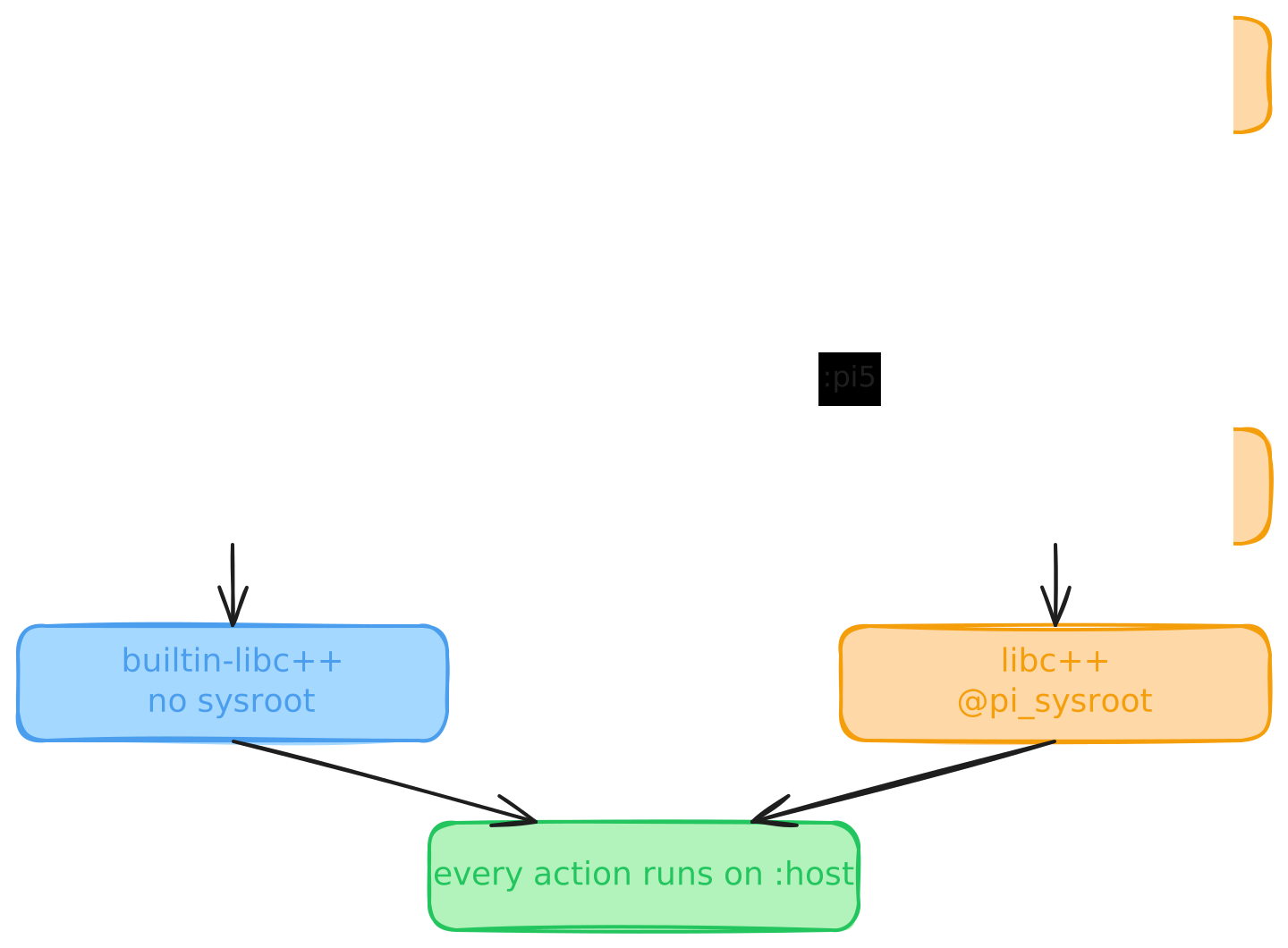
Note the bottom box. Both builds run every action on the same x86_64 machine; only the target side of the match moves.
One Config per Target
Picking the target is a named config in .bazelrc. bazel build --config=host //... is the host build, for the workstation; bazel build --config=pi //... is the Pi build. Each config is nothing but a platform choice, and this is every per-target line in the file:
build:host --platforms=//bazel/platforms:host

build:pi --platforms=//bazel/platforms:pi5
The whole .bazelrc is 23 lines, and the rest is lockfile strictness, three output-directory flags covered near the end, a CI config, test output settings and a user.bazelrc import. The A76 tuning used to live here too, as two build:pi --copt lines. That had a real gap: the tuning was tied to a config name, not to the target, so a plain bazel build --platforms=//bazel/platforms:pi5 produced an untuned binary without a word of complaint. The flags now sit on the toolchain itself, keyed to the Pi's target pair:
    # @platforms has no cortex-a76 constraint value, so A76 tuning can only be a
    # compiler flag rather than a platform property. Keyed to the target pair
    # rather than set under build:pi, so the tuning follows the toolchain: a
    # plain --platforms=//bazel/platforms:pi5 build gets it too.
    extra_compile_flags = {"linux-aarch64": [
        "-mcpu=cortex-a76",
        "-mtune=cortex-a76",
    ]},
aquery on that bare --platforms build found zero tuning flags before the move and two after. Keying by pair also keeps the flags out of everything else. The host compile action carries no cortex-a76 flag, and neither will a tool that runs during the build (a code generator, say), because those get built for the exec platform, which is x86_64-linux.
There's no --extra_toolchains line, and that's worth a detour, because an earlier version of this repo had one. The host toolchain was registered globally with register_toolchains("@llvm_host//:all") and the cross one was selected by label, on the theory that registering both would leave resolution order to arbitrate between them. The theory was right. The premise was wrong.
Ask toolchains_llvm what @llvm_pi actually generates and you get five:
$ bazel query '@llvm_pi//:all' | grep cc-toolchain-
@llvm_pi//:cc-toolchain-aarch64-linux
@llvm_pi//:cc-toolchain-riscv32-none
@llvm_pi//:cc-toolchain-riscv64-none
@llvm_pi//:cc-toolchain-x86_64-linux
@llvm_pi//:cc-toolchain-x86_64-none
That's the aarch64-linux pair, the native x86_64-linux pair, and three bare-metal pairs that need no sysroot. Now run the same query against the host-only toolchain the repo used to have (git checkout f550049 first, since it no longer exists on main) and you get exactly those five minus aarch64-linux. toolchains_llvm emits a cross pair only when it has a sysroot for it, and the host toolchain had none, so it could never have shadowed the Pi. @llvm_pi is a strict superset: diff the two generated BUILD files at that commit and you get 144 added lines, nothing removed and nothing changed.
Which inverts the fix. Registering both would put two x86_64-linux candidates in front of every host build, with order picking the winner, so I registered @llvm_pi//:all alone and deleted the host toolchain entirely:
# Registered globally rather than selected by label under build:pi. Nothing
# arbitrates: aarch64-linux is the only candidate for //bazel/platforms:pi5,
# x86_64-linux the only one for :host.
register_toolchains("@llvm_pi//:all")
That's the whole mechanism, and it's why .bazelrc above has nothing to say about toolchains any more: it picks a platform and the registration does the rest. One registration serves both configs, and the --extra_toolchains line goes away along with nineteen lines of MODULE.bazel. I compared the link command lines before and after under both configs: flag for flag identical, down to the sysroot path and the order of the archives. The only thing that changes is which repo's cc_wrapper.sh runs, and the two are byte-identical.
The :all in that line isn't special syntax. It's the ordinary "everything in this package" pattern, and @llvm_pi holds 120 targets: filegroups, the cc_toolchain rules, wrappers for clangd and clang-format, and so on. register_toolchains silently skips everything that isn't a toolchain() and keeps the five that are. I'd rather have that than a hand-written list of labels. A toolchains_llvm upgrade that adds or renames a target would leave an explicit list quietly incomplete, while :all just picks up whatever got generated.
Registering a toolchain doesn't mean it gets used, though. All five land in the candidate list, and resolution throws out the ones whose constraints don't fit. --toolchain_resolution_debug shows it happening (repo prefixes shortened, most rejections cut):
$ bazel cquery --config=pi \
    --toolchain_resolution_debug='@bazel_tools//tools/cpp:toolchain_type' \
    //src/hello:hello

ToolchainResolution:   Toolchain @@…llvm_pi//:cc-toolchain-aarch64-linux (resolves to
  @@…llvm_pi//:cc-clang-aarch64-linux) is compatible with target platform, searching
  for execution platforms:
ToolchainResolution:   Rejected toolchain @@…llvm_pi//:cc-toolchain-x86_64-linux
  (resolves to @@…llvm_pi//:cc-clang-x86_64-linux) ; mismatching values: x86_64
ToolchainResolution:   Rejected toolchain @@…local_config_cc_toolchains//:cc-toolchain-k8
  (resolves to @@…local_config_cc//:cc-compiler-k8) ; mismatching values: x86_64
Every line names two targets because cc-toolchain-* is the toolchain() wrapper that gets registered, and cc-clang-* is the actual cc_toolchain behind it. The last line isn't mine at all: rules_cc (and apple_support) register their own autodetected toolchains, and resolution walks past those too. If a rerun prints nothing, that's the analysis cache. The debug output only appears when resolution actually runs.
There's one cost. With @llvm_host gone, host builds come out of @llvm_pi too, from its x86_64-linux toolchain. So every setting in the llvm.toolchain(name = "llvm_pi") block also applies to host builds, unless it's keyed to a specific target pair. stdlib is the one that matters here. It's keyed to linux-aarch64, so only Pi builds get libc++. Change the key to "" (an easy mistake when the block is literally named llvm_pi) and host builds quietly switch away from builtin-libc++ as well. A separate host toolchain made that mistake impossible. Now the only guard is a comment above that line in MODULE.bazel.
Where the Toolchain Comes From
Writing a cc_toolchain_config by hand is a waste of a weekend. toolchains_llvm6 generates the toolchain, its features and its flag sets from a few tags in MODULE.bazel, so the interesting work is in the parts it can't decide for you.
The first one surprised me. An LLVM release tarball is two different things glued together. LLVM-23.1.0-Linux-X64 carries clang, clang++ and ld.lld as x86_64 binaries, which every build needs to run, plus x86_64 headers and lib/x86_64-unknown-linux-gnu/libc++.a, which the host build links and the Pi build can't use. The aarch64 archives only exist in LLVM-23.1.0-Linux-ARM64, whose binaries can't execute on my workstation at all. So the Pi toolchain, @llvm_pi's aarch64-linux entry, is assembled from two distributions:
MODULE.bazel:74-115, with the two flag attributes elided:
llvm.toolchain(
    name = "llvm_pi",
    cxx_standard = {"": "c++23"},
    # extra_compile_flags = {...}, extra_link_flags = {...}
    llvm_version = _LLVM_VERSION,
    # Keyed to the aarch64 target rather than "" because this toolchain also
    # serves host builds: an empty key would move them off builtin-libc++ too,
    # with nothing in a --config=host command line pointing at the cause.
    stdlib = {"linux-aarch64": "libc++"},
)
llvm.toolchain_root(
    name = "llvm_pi",
    label = "@llvm_x64//:BUILD",
)
llvm.target_toolchain_root(
    name = "llvm_pi",
    label = "@llvm_arm64//:BUILD",
    targets = ["linux-aarch64"],
)
llvm.sysroot(
    name = "llvm_pi",
    label = "@pi_sysroot//sysroot",
    targets = ["linux-aarch64"],
)
toolchain_root is the distribution whose binaries run. target_toolchain_root is the one you compile against and link with. Both tags read only the package path out of the label, which explains the odd-looking @llvm_x64//:BUILD. (Both trees are fetched by sha256 through a small repository rule of mine. It exists for a linker problem with my workstation's system libraries that has nothing to do with cross-compilation, so I'll skip it here.)
@llvm_arm64 supplies more than the aarch64 runtime archives (libc++.a, libc++abi.a, libunwind.a, compiler-rt). Run aquery on a Pi compile action and you'll see -resource-dir pointing at @llvm_arm64/lib/clang/23, -nostdinc++, and two -cxx-isystem paths into @llvm_arm64/include. So the target-side C++ headers and the clang resource directory come from the ARM64 tree too. For the Pi build, the X64 tree contributes executables and nothing else. The host build gets everything from the X64 tree, because x86_64-linux has no target_toolchain_root and falls back to toolchain_root.
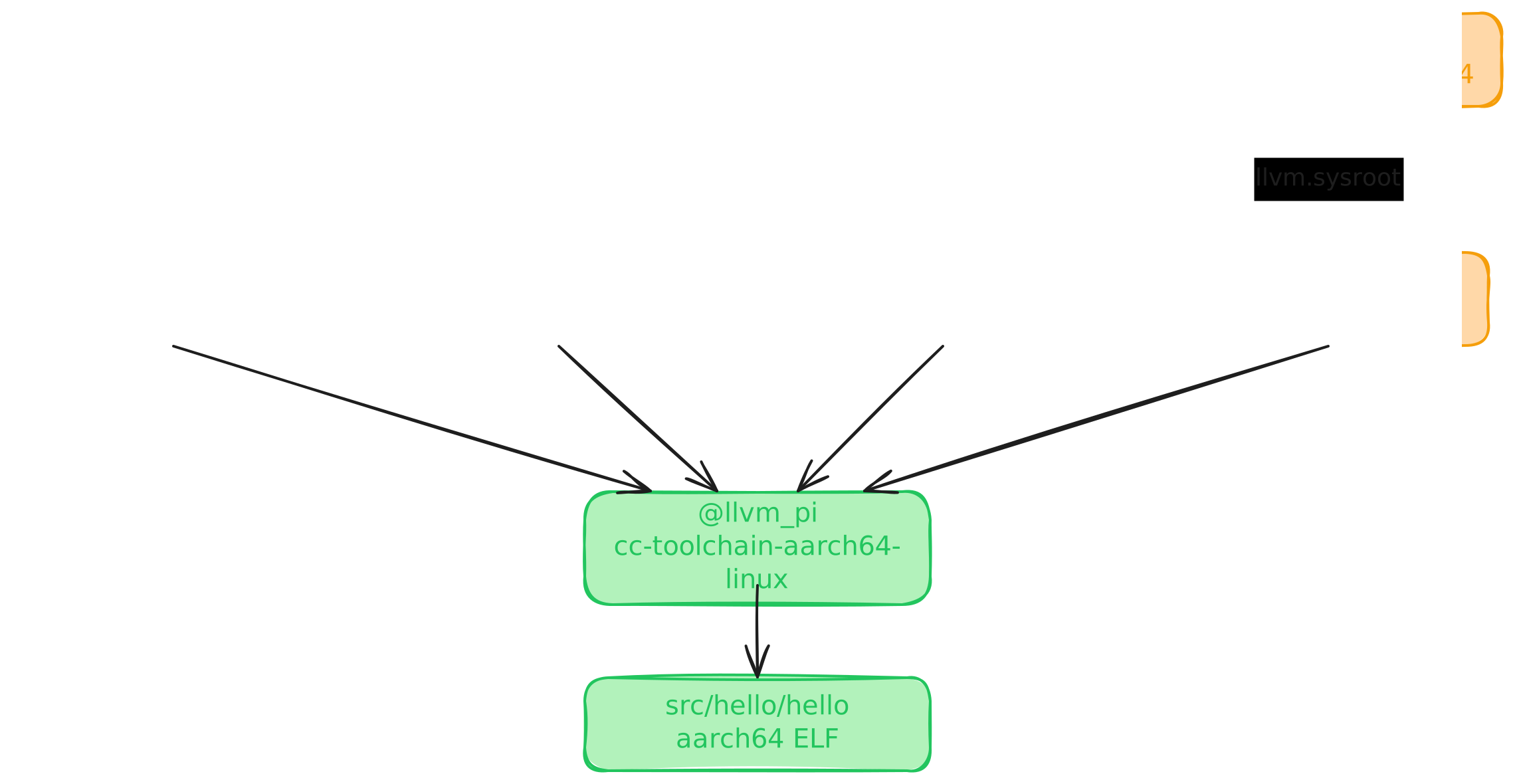
One thing I didn't expect: pointing toolchain_root at a tree you've already fetched also skips toolchains_llvm's own LLVM download. The generated @llvm_pi repo is 39 KB of BUILD files and a cc_wrapper.sh, not a third copy of a 12 GB distribution.
The Sysroot
The C side (glibc headers, libc.so.6, libm, libpthread) comes from a sysroot. The obvious way to bring one in is http_archive plus a filegroup with a glob(). Don't. On the sysroot used here, that glob produces a warning naming 6,749 files, and every one of them becomes a separate input symlinked into every compile and link sandbox.
toolchains_llvm ships its own sysroot repository rule, and it declares the extracted tree as a single source directory (srcs = ["."]). That's one input in the action graph and one symlink per sandbox instead of thousands. It also extracts with a hermetic bsdtar instead of whatever tar the build machine has.
For now the sysroot itself is borrowed. Chromium builds Debian sysroots for its own cross-compiles and publishes them as immutable tarballs, and toolchains_llvm's own tests use the same ones, so it was the quickest way to get a working one. Mine is their Debian stretch arm64 image, with glibc 2.24. The Pi runs 2.41 and glibc is forward-compatible in that direction, so the artifacts carry a lower symbol floor than intended rather than a broken one. A Debian trixie snapshot replaces it next, and the label @pi_sysroot//sysroot won't move when that happens.
This is what reaches the linker. I pulled it with bazel aquery --config=pi 'mnemonic("CppLink", //src/hello:hello)' and trimmed the hardening flags:
exec external/toolchains_llvm++llvm+llvm_pi/bin/cc_wrapper.sh \
  -o bazel-out/pi5-fastbuild/bin/src/hello/hello \
  --target=aarch64-unknown-linux-gnu -fuse-ld=lld \
  -resource-dir external/+llvm_distribution+llvm_arm64/lib/clang/23 \
  -rtlib=compiler-rt -l:libunwind.a -lpthread -ldl \
  bazel-out/pi5-fastbuild/bin/src/hello/_objs/hello/main.pic.o \
  -Wl,--start-lib bazel-out/.../hello_lib/hello.pic.o -Wl,--end-lib \
  --sysroot=external/+sysroot+pi_sysroot/sysroot/ \
  -Lexternal/+llvm_distribution+llvm_arm64/lib \
  -Lexternal/+llvm_distribution+llvm_arm64/lib/aarch64-unknown-linux-gnu \
  -l:libc++.a -l:libc++abi.a
The detail I care about most is that --sysroot is workspace-relative. Nothing in the command line knows where my checkout lives, so the action key doesn't either. There's no shared cache here yet, but once there is, a CI runner and my workstation will compute the same key for this link even though the checkouts live at different paths. An absolute path would have made every machine's keys unique. (Why that output path says pi5-fastbuild gets a section near the end.)
If I had to recommend one Bazel habit for toolchain work, it's this one: when something looks wrong, read the action with aquery4 instead of guessing. Every finding in the next section came out of a command line or an input list.
Defaults That Fail Quietly
libstdc++ through the back door
toolchains_llvm controls the C++ runtime through a stdlib attribute, and the default is builtin-libc++: static libc++ and libc++abi, plus compiler-rt and libunwind. Sounds exactly like what I want. But when exec and target architectures differ, the toolchain config rewrites that default:
toolchain/cc_toolchain_config.bzl:437-438 (toolchains_llvm 1.9.0)
    if stdlib == "builtin-libc++" and is_xcompile and not is_darwin_exec_and_target:
        stdlib = "stdc++"
Leave stdlib alone and the Pi build takes its C++ standard library from the sysroot. With the stretch sysroot this project uses today, you find out immediately, because nothing compiles:
./src/hello/hello.h:3:10: fatal error: 'expected' file not found
    3 | #include <expected>
      |          ^~~~~~~~~~
aquery shows why. The compile action gets -stdlib=libstdc++ and no -nostdinc++, so <expected> is looked up in external/+sysroot+pi_sysroot/sysroot/usr/include/c++/6.3.0, the libstdc++ headers that came inside the sysroot tarball. The build machine's own /usr/include plays no part. Debian stretch ships GCC 6.3, and its libstdc++ has no <expected>, <flat_map> or <print>. With the libc++ key set, the same action gets -nostdinc++ and two -cxx-isystem paths, and the headers come from @llvm_arm64/include/c++/v1 instead.
A failing compile is the lucky outcome. With a sysroot whose libstdc++ is new enough, the build goes green and nothing tells you that the binary now loads libstdc++.so.6 from the Pi at runtime, or that hello_test on the workstation exercises libc++ while the Pi runs libstdc++. The neighbouring branch, an empty stdlib on a cross build, at least prints a warning. This one prints nothing.
The fix is stdlib = {"linux-aarch64": "libc++"}, keyed by the target pair. An empty key would apply to every pair, including x86_64-linux, and drag the host build off builtin-libc++ as well.
Except the libc++ value isn't builtin-libc++ minus the cross rewrite. It emits -l:libc++.a -l:libc++abi.a and nothing more, so the first link died like this:
ld.lld: error: undefined symbol: __aarch64_ldadd8_acq_rel
ld.lld: error: undefined symbol: __aarch64_ldadd8_relax
ld.lld: error: undefined symbol: __aarch64_cas8_acq_rel
Those are AArch64's outline-atomics helpers, small functions the compiler calls for atomic operations. libc++.a and libc++abi.a both use them, and they live in compiler-rt, which the libc++ mode never links. It skips the unwinder, pthread and dl as well, all of which builtin-libc++ brings along for free. Four flags on the toolchain, keyed to the Pi's pair again, put all of that back:
    # The libc++ stdlib branch emits only -l:libc++.a -l:libc++abi.a, unlike
    # builtin-libc++: AArch64 outline-atomics live in compiler-rt, and libunwind,
    # pthread and dl are otherwise supplied for free. extra_link_flags appends to
    # the toolchain's own link_flags, so these land before the object files,
    # where builtin-libc++ puts them on the host.
    extra_link_flags = {"linux-aarch64": [
        "-rtlib=compiler-rt",
        "-l:libunwind.a",
        "-lpthread",
        "-ldl",
    ]},
-rtlib=compiler-rt brings in the atomics. -l:libunwind.a names the static archive on purpose: -unwindlib=libunwind looks equivalent, but it links the shared libunwind.so and puts a runtime dependency back on the Pi. -lpthread and -ldl resolve against the sysroot's glibc.
The attribute name matters. toolchains_llvm has two families of flag attributes, both keyed by target pair. compile_flags, link_flags and link_libs replace the toolchain's computed defaults, so using them means restating everything the toolchain already emits. Their extra_* twins append after the defaults, which is what you want almost every time.
Don't count on upstream to catch a regression here. toolchains_llvm 1.9.0's CI tests every stdlib value, but only in native builds7. Its one cross-compile test leaves stdlib unset8, so it takes the silent libstdc++ path described above. Nothing upstream builds cross with libc++, so in this repo the ABI check further down is the only guard on that combination.
A file nobody declared
The second quiet failure looked like a broken include path and wasn't one:
fatal error: '__config_site' file not found
The -cxx-isystem path pointed exactly where __config_site lives in the ARM64 tree. The file simply wasn't in the sandbox. Each compile action's inputs come from a generated filegroup:
toolchain/internal/configure.bzl:706-715 (toolchains_llvm 1.9.0)
filegroup(
    name = "compiler-components-{suffix}",
    srcs = [
        ":cxx_builtin_include_files-{suffix}",
        ":sysroot-components-{suffix}",
        "{llvm_dist_label_prefix}extra_config_site",
        "{toolchain_root}:clang",
        {extra_compiler_files}
    ],
)
{llvm_dist_label_prefix} is the exec distribution. With one distribution serving both sides that's correct. With X64 as exec and ARM64 as target, it declares the x86_64 __config_site and nobody declares the aarch64 copy that the include path actually resolves to. The template quietly assumes exec and target are the same tree.
The fix is one tag:
llvm.extra_compiler_files(
    name = "llvm_pi",
    label = "@llvm_arm64//:extra_config_site",
    targets = ["linux-aarch64"],
)
This is the pattern to recognise, because any cross setup built from two trees will hit it again: a sandboxed action fails not because a path is wrong, but because a correct path was never declared as an input. The error talks about a missing file. The actual bug is a missing declaration. extra_compiler_files and its twin extra_linker_files are the escape hatches, and aquery's input list tells you which one you need.
An Execution Platform Nothing Runs On
This block looks wrong, and most reviewers would recommend deleting it:
# Test-toolchain resolution needs a registered execution platform matching the
# target platform before it consults a target's exec_compatible_with, so :pi5
# must be registered even though no action ever runs on aarch64 hardware.
register_execution_platforms(
    "//bazel/platforms:host",
    "//bazel/platforms:pi5",
)
No action in this project ever executes on aarch64. Remove :pi5 anyway, and bazel test --config=pi //... fails at analysis:
ERROR: .../bazel/deploy/BUILD.bazel:5:8: While resolving toolchains for target
//bazel/deploy:device_smoke (d9c8cc0): No matching toolchains found for types:
  @@bazel_tools//tools/test:default_test_toolchain_type: By default, tests are
  executed on the first execution platform that matches all constraints specified
  by the target platform. Either register the target platform (or a platform with
  at least the same constraints) as an execution platform, or override the default
  behavior by registering a custom toolchain for
  @bazel_tools//tools/test:default_test_toolchain_type.
To its credit, Bazel 9 says exactly what to do. What's surprising is the reason. A test whose target platform is aarch64 needs an aarch64 execution platform to exist, even when its own exec_compatible_with sends every action to x86_64. Registering :pi5 satisfies that check, and nothing ever runs on it. The other way out, a custom toolchain for default_test_toolchain_type, is more machinery for the same result. Restore the line and the suite goes green again.
Order matters here too. :host is listed first, so every action that doesn't constrain its own exec platform lands on the build machine. In a --config=pi build the compile, link and genrule actions all report Execution platform: //bazel/platforms:host, which is what you want.
Tests That Know Which Side They're On
target_compatible_with is how one bazel test //... stays correct under both configs:
| Target | target_compatible_with |
--config=host |
--config=pi |
|---|---|---|---|
//src/hello:hello_test |
x86_64 | runs | skipped |
//bazel/deploy:cross_artifact_abi_check |
aarch64 | skipped | runs, no Pi needed |
//bazel/deploy:device_smoke |
aarch64 | skipped | runs, needs the Pi |
Incompatible tests are skipped, not failed, and that cuts both ways. Incompatibility is transitive, data edges included: a CPU constraint on hello_lib would make hello incompatible in the Pi build, device_smoke with it, and the run would report green with the device test silently skipped. That's why hello_lib stays unconstrained, with a comment saying so.
The two tests in bazel/deploy check an aarch64 binary from the x86_64 build machine, and Bazel can express that directly:
bazel/deploy/BUILD.bazel:41-56
sh_test(
    name = "cross_artifact_abi_check",
    size = "small",
    srcs = ["cross_artifact_abi_check.sh"],
    args = ["$(rlocationpath @llvm_x64//:readelf)"],
    data = [
        "//src/hello",
        "@llvm_x64//:readelf",
    ],
    exec_compatible_with = [
        "@platforms//cpu:x86_64",
        "@platforms//os:linux",
    ],
    target_compatible_with = ["@platforms//cpu:aarch64"],
    deps = ["@rules_shell//shell/runfiles"],
)
target_compatible_with puts the test in the Pi build, so data brings in //src/hello as the aarch64 binary. exec_compatible_with keeps the test itself, the cross_artifact_abi_check.sh script, on the x86_64 build machine. @llvm_x64//:readelf sits in data too and survives the aarch64 configuration only because it's a filegroup around a prebuilt binary; a cc_binary in the same slot would come out as aarch64 and fail to start. With that readelf, the script checks the two things all the toolchain work was for: the artifact is AArch64, and its NEEDED list has libc.so.6 but no libstdc++, libc++ or libgcc_s.
device_smoke has the same shape, plus scp and ssh to prove the binary actually runs on the Pi. env_inherit forwards HOME, SSH_AUTH_SOCK and PI_SSH_HOST to this one test only, and the external tag keeps its result out of the cache.
One Output Directory for Two Targets
Until recently, both configs wrote to the same place. bazel aquery on the link action reported bazel-out/k8-fastbuild/bin/src/hello/hello under --config=host and --config=pi alike, so bazel-bin/src/hello/hello was whichever build ran last. I hit it while checking something else: an x86-64 ELF sitting at the path an aarch64 build had produced earlier in the same session. It's also why the ABI check lives inside the build graph and not as a file bazel-bin/... line in the README.
k8 is Bazel's legacy CPU name for x86_64, and despite the look, no relation to k8s. It's named after AMD's K8, the Athlon 64 and Opteron family that shipped the first x86-64 chips, and it came over from Blaze, Google's internal build system, together with piii for 32-bit x86. rules_cc still carries the mapping5:
return "k8" if arch in ["amd64", "x86_64", "x64"] else "piii"
The output directory is named <cpu>-<compilation_mode>, and <cpu> comes from the deprecated --cpu flag. Nothing here sets it, so Bazel falls back to the host's legacy name and every build gets k8, the Pi build included. That's also why bazel config shows cpu: k8 for the Pi configuration right next to platforms: //bazel/platforms:pi5. It looks contradictory, but nothing reads that field, and $(TARGET_CPU) correctly says aarch64. The CPU value was never wrong. The target platform just never reached the path.
Three lines in .bazelrc fix it:
common --experimental_platform_in_output_dir=yes
common --experimental_override_platform_cpu_name=//bazel/platforms:host=host
common --experimental_override_platform_cpu_name=//bazel/platforms:pi5=pi5
The first puts a platform name in the output path instead of the CPU. The other two pick those names explicitly instead of leaving them to an inference scheme Bazel documents as experimental. Outputs now land in bazel-out/host-fastbuild and bazel-out/pi5-fastbuild and coexist on disk. The lines use common rather than build so test, cquery and aquery all agree on the paths. Both flags are still experimental, so a future Bazel may rename them.
Two things stay as they were. bazel-bin is a single symlink and still follows the last build, so a stable path means asking bazel cquery --output=files. And switching configs still discards the analysis cache, because --platforms is a configuration input no matter where the outputs land.
Next Board, Next Steps
Moving this to a different aarch64 Linux board is a short edit: a new platform() (possibly with the same two constraints), different -mcpu/-mtune in extra_compile_flags, a different sysroot. A different architecture, say armv7 or riscv64, adds a matching target_toolchain_root distribution and a new stdlib key. src/ doesn't change in either case, which was the point of keeping every per-target difference in the toolchain declaration.
For this project, the next step is replacing the stretch sysroot with a Debian trixie snapshot that matches the Pi's actual glibc. After that, GStreamer and friends go in through third_party/ as C libraries. That last part matters more than it sounds: the static libc++ decision only holds as long as no C++ library from the sysroot ever lands on the link line. Then a remote cache, because ~/.cache/bazel on my workstation is already at 62 GB.